Collective action for conservation

There is strong evidence that effective land management often requires access to large, continuous areas - something more easily achieved through groups of farmers and other landholders working together. Trust is essential to ensure that funding promotes meaningful and effective collaboration. This tool places trust at the center, recognizing that the entire process depends on building and maintaining it.
What you will achieve with this action?
Unpack the importance of funding group faciliation for landscape-scale conservation.
Get inspired by: England’s Countryside Stewardship Facilitation Fund (CSFF)
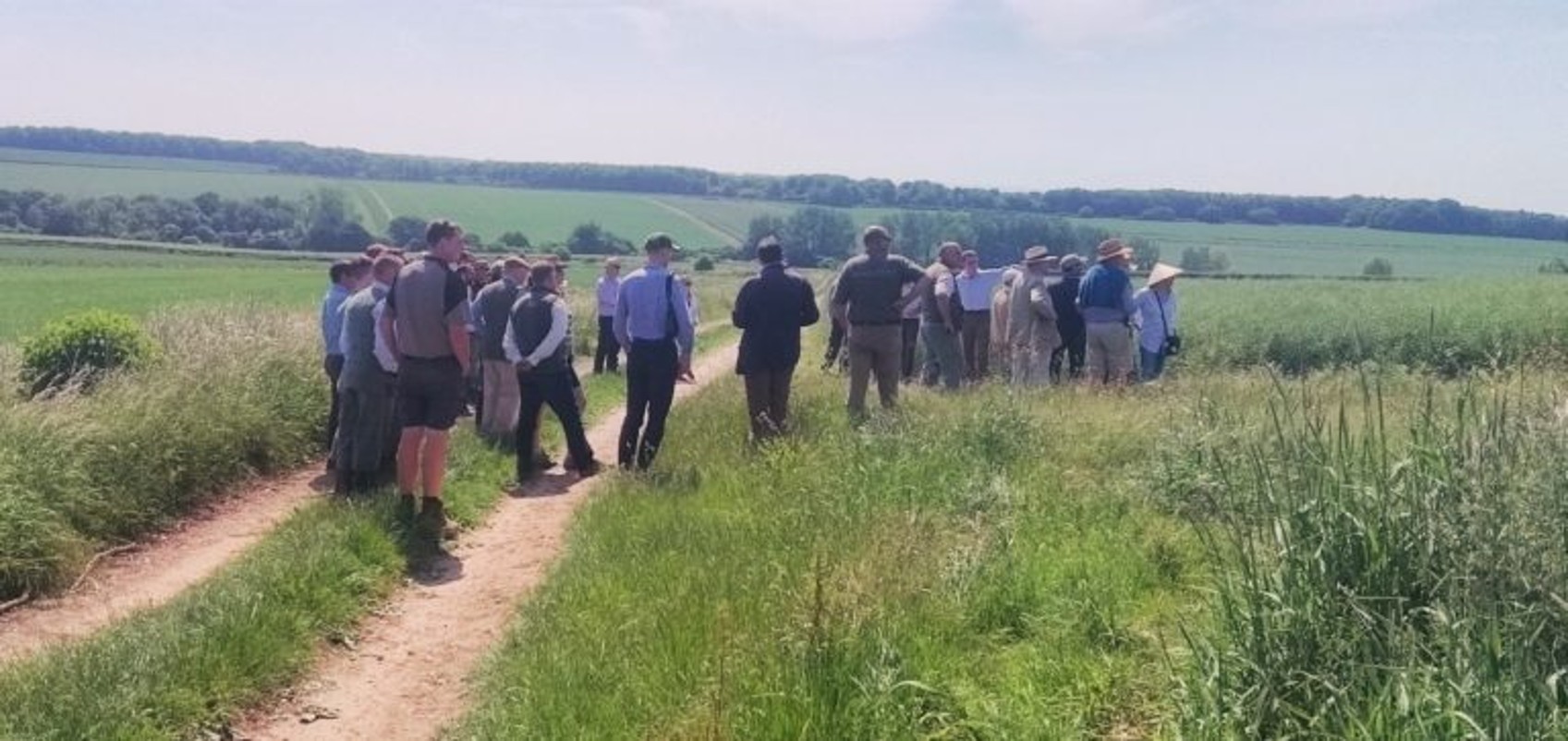
After limited success with individualised agri-environment payments under the Common Agricultural Policy (CAP), grassroots farmer clusters emerged as an alternative approach to implementing conservation on farmland. These clusters aim to foster coordinated action among local land managers to ensure conservation is “bigger, better, and more joined-up” (Lawton, 2011). Building on these early experiments in collaborative conservation, the government in England launched the CSFF in 2015 to:
Fund farmer group facilitation
Achieve more effective environmental outcomes at landscape scale
To date:
8 funding rounds have been completed
£2.5 million allocated per round
220 groups created (100 still active)
Over 6,000 members involved
450,000 hectares of farmland covered
Although the funding has now been closed to new applicants, the CSFF has shown that funding collaborative land management, grounded in trust, can contribute to meaningful conservation.
Explore how to take action
Remember, this is an inspiration guide (not a recipe) to help you decide what will be most transformative for your context. Every context is unique!
With whom and for whom are you transforming?
Is sufficient funding allocated for network facilitation in your landscape-scale initiative?
What actions are you taking to keep collaboration a lived, ongoing process?
What unintended consequences might arise (e.g., exclusion of non-funded groups)?
Effective landscape-scale conservation depends on farmers’ buy-in to collaboration.
This is crucial for achieving scale and ensuring those tasked with implementing conservation measures see value in long-term participation. Anticipating unintended consequences allows early steps to mitigate harm and proactively integrate solutions.
Exclusion is one of the most imminent negative consequences, and this must not become a constant or deliberate exclusion of specific groups.
For those who cannot be included in the program due to budget constraints, alternative pathways, such as opening dialogue tables, can ensure their voices are heard and perspectives considered.
By fostering inclusive networks and sustained dialogue, this tool helps align diverse stakeholders toward shared goals, reducing fragmentation and building trust and collaboration, the heart of collective action for conservation and a nature-positive, climate-neutral future.
References
Adams, W.M. et al. (2016) ‘Creating restoration landscapes’, Ecology and Society, 21(3). Available at: http://www.jstor.org/stable/26269947 (Accessed: 17 September 2025).
Adams, W.M., Hodge, I.D. and Sandbrook, L. (2014) ‘New spaces for nature: the re-territorialisation of biodiversity conservation under neoliberalism in the UK’, Transactions of the Institute of British Geographers, 39(4), pp. 574–588. Available at: http://www.jstor.org/stable/24582931 (Accessed: 7 March 2024).
Bateman, I.J. and Balmford, B. (2018) ‘Public funding for public goods: A post-Brexit perspective on principles for agricultural policy’, Land Use Policy, 79, pp. 293–300. Available at: https://doi.org/10.1016/j.landusepol.2018.08.022.
Bennett, A.F. and Saunders, D.A. (2010) ‘88Habitat fragmentation and landscape change’, in N.S. Sodhi and P.R. Ehrlich (eds) Conservation Biology for All. Oxford University Press, p. 0. Available at: https://doi.org/10.1093/acprof:oso/9780199554232.003.0006.
Brown, C. et al. (2021) ‘Simplistic understandings of farmer motivations could undermine the environmental potential of the common agricultural policy’, Land Use Policy, 101, p. 105136. Available at: https://doi.org/10.1016/j.landusepol.2020.105136.
Burton, R. (2021) The good farmer: culture and identity in food and agriculture / Rob J.F. Burton, Jérémie Forney, Paul Stock, and Lee-Ann Sutherland. Abingdon, Oxon ; Routledge (Earthscan food and agriculture series).
Crooks, K.R. and Sanjayan, M. (2006) ‘Connectivity conservation: maintaining connections for nature’, in K.R. Crooks and M.E. Sanjayan (eds) Connectivity Conservation. Cambridge University Press (Conservation Biology), pp. 1–20.
Cusworth, G. (2020) ‘Falling short of being the “good farmer”: Losses of social and cultural capital incurred through environmental mismanagement, and the long-term impacts agri-environment scheme participation’, Journal of Rural Studies, 75, pp. 164–173. Available at: https://doi.org/10.1016/j.jrurstud.2020.01.021.
Defra (2018) ‘A Green Future: Our 25 Year Plan to Improve the Environment. Department for Environment Food, and Rural Affairs.’ Available at: https://www.gov.uk/government/publications/25-year-environment-plan.
Defra (2021) Environment Act. Statute Law Database. Available at: https://www.legislation.gov.uk/ukpga/2021/30/contents (Accessed: 17 September 2025).
Farmer Opinion Tracker (2025) GOV.UK. Available at: https://www.gov.uk/government/collections/farmer-opinion-tracker (Accessed: 17 September 2025).
Farming Toolkit for Assessing Nature Market Opportunities (2025). Available at: https://hive.greenfinanceinstitute.com/gfihive/farming-toolkit (Accessed: 17 September 2025).
Franks, J.R. (2019) ‘An assessment of the landscape-scale dimensions of land based environmental management schemes offered to farmers in England’, Land Use Policy, 83, pp. 147–159. Available at: https://doi.org/10.1016/j.landusepol.2019.01.044.
Hodge, I. (2001) ‘Beyond agri-environmental policy: towards an alternative model of rural environmental governance’, Land Use Policy, 18(2), pp. 99–111. Available at: https://doi.org/10.1016/S0264-8377(01)00002-3.
Hodge, I. (2024) ‘The potential for local environmental governance: A case study of Natural Cambridgeshire’, Journal for Nature Conservation, 79, p. 126631. Available at: https://doi.org/10.1016/j.jnc.2024.126631.
IPBES (2024) Thematic Assessment Report on the Interlinkages among Biodiversity, Water, Food and Health of the Intergovernmental Science-Policy Platform on Biodiversity and Ecosystem Services. Edited by P.A. Harrison, P.D. McElwee, and T.L. van Huysen. Bonn, Germany: IPBES Secretariat. Available at: https://doi.org/10.5281/zenodo.13850054.
Kam, H. (2024) ‘Opportunities for achieving landscape scale conservation in England’, Journal of Rural Studies, 110. Available at: https://doi.org/10.1016/j.jrurstud.2024.103380.
Kovács, E.K., Kalóczkai, Á. and Czúcz, B. (2021) ‘The role of politics in the life of a conservation incentive: An analysis of agri-environment schemes in Hungary’, Biological Conservation, 259. Available at: https://doi.org/10.1016/j.biocon.2021.109172.
Lawton J H, Brotherton P N M, Brown V K, Elphick C, Fitter A H, Forshaw J, Haddow R W, Hilborne S, Leafe R N, Mace G M, Southgate M P, Sutherland W J, Tew T E, Varley J and Wynne G R 2010 Making space for nature: a review of England’s wildlife sites and ecological network Report to DEFRA
Luhmann, N. (1979). Trust and power. Chichester: Wiley
Mills, J. et al. (2021) ‘Developing Farm-Level Social Indicators for Agri-Environment Schemes: A Focus on the Agents of Change’, Sustainability, 13(14), p. 7820. Available at: https://doi.org/10.3390/su13147820.
Nichols, R.N. et al. (2025) ‘Forming and managing a Farmer Cluster for improved farmland biodiversity in Europe’, Ecological Solutions and Evidence, 6(3), p. e70097. Available at: https://doi.org/10.1002/2688-8319.70097.
Prager, K. (2022) ‘Implementing policy interventions to support farmer cooperation for environmental benefits’, Land Use Policy, 119. Available at: https://doi.org/10.1016/j.landusepol.2022.106182.
Riley, M. et al. (2018) ‘Will farmers work together for conservation? The potential limits of farmers’ cooperation in agri-environment measures’, Land Use Policy, 70, pp. 635–646. Available at: https://doi.org/10.1016/j.landusepol.2017.10.049.
Rousseau DM, Sitkin SB, Burt RS, et al. (1998) Not so different after all: A cross-discipline view of trust. Academy of Management Review 23(3): 393–404
Ruto, E. and Garrod, G. (2009) ‘Investigating farmers’ preferences for the design of agri-environment schemes: a choice experiment approach’, Journal of Environmental Planning and Management, 52(5), pp. 631–647. Available at: https://doi.org/10.1080/09640560902958172.
Science Search (no date). Available at: https://sciencesearch.defra.gov.uk/ProjectDetails?ProjectId=21825 (Accessed: 17 September 2025).
Sutherland, L.-A. and Marchand, F. (2021) ‘On-farm demonstration: enabling peer-to-peer learning’, The Journal of Agricultural Education and Extension, 27(5), pp. 573–590. Available at: https://doi.org/10.1080/1389224X.2021.1959716.
de Vries, J.R. et al. (2019) ‘Trusting the People and the System. The Interrelation Between Interpersonal and Institutional Trust in Collective Action for Agri-Environmental Management’, Sustainability, 11(24), p. 7022. Available at: https://doi.org/10.3390/su11247022.
Weipert-Fenner, I. et al. (2024) ‘Trust and social movements: A new research agenda’, International Journal of Comparative Sociology, 65(4), pp. 409–422. Available at: https://doi.org/10.1177/00207152241246216.
Westerink, J. et al. (2017) ‘Collaborative governance arrangements to deliver spatially coordinated agri-environmental management’, Land Use Policy, 69, pp. 176–192. Available at: https://doi.org/10.1016/j.landusepol.2017.09.002.
Wheeler, R. et al. (2023) ‘“It’s a lonely old world”: Developing a multidimensional understanding of loneliness in farming’, Sociologia Ruralis, 63(S1), pp. 11–36. Available at: https://doi.org/10.1111/soru.12399.