Cross-sectoral linkages

Transformative pathways for biodiversity and climate change mitigation require multiple, coordinated interventions across sectors. As well as conventional measures such as protected areas and carbon markets, these pathways include actions like sustainable agricultural intensification, reducing food waste, and changing diets. Combining these measures enables us to maximise synergies, minimise trade-offs, and deliver the greatest potential for transformative change for climate, biodiversity, and society.
What you will achieve with this action?
Emphasise that cross-sector collaboration is not only beneficial but also essential to overcoming sustainability challenges and enabling transformative change.
Get inspired by: Future scenarios that pursue an integrative approach offer the greatest advantages.
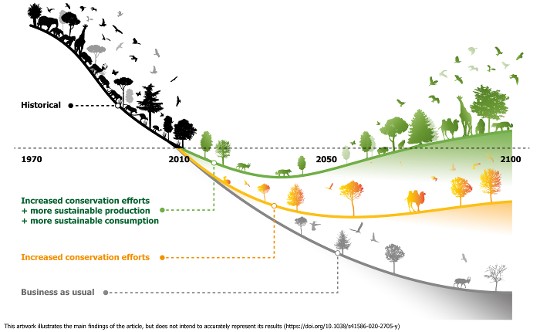
According to Leclère et al. (2020), an integrated strategy is required to bend the curve of terrestrial biodiversity loss. In addition to conventional nature conservation measures, actions that promote a circular economy and encourage more sustainable production and consumption can help to curb the decline in global biodiversity. Figure adapted from: https://iiasa.ac.at/news/sep-2020/bending-curve-of-biodiversity-loss. Credit: Adam Islaam, IIASA.
Explore how to take action
Remember, this is an inspiration guide (not a recipe) to help you decide what will be most transformative for your context. Every context is unique!
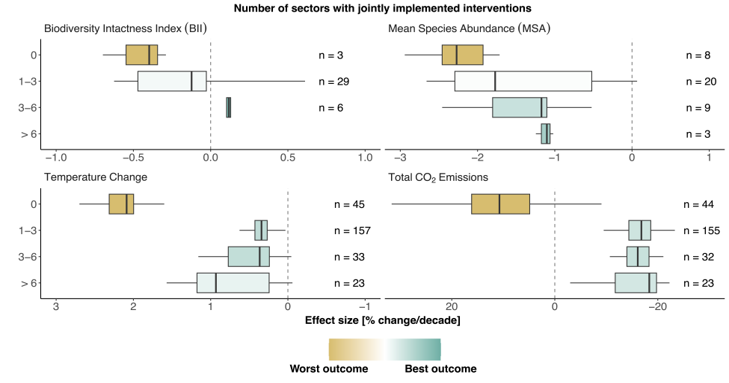 Figure 2: The boxplots illustrate the decadal percentage change in temperature since the pre-industrial age (1850–1900), as well as the percentage change per decade in total CO₂ emissions, the biodiversity intactness index (BII) and mean species abundance (MSA). These are categorized by the number of sectors with jointly implemented interventions. The boxplots show the distribution of each metric across sample sizes (i.e. scenarios). Temperature change and CO₂ emissions are expressed relative to the average global temperature and CO₂ emissions for the reference period of 1991–2020 (Figure adapted and modified from: Neumann et al. 2025a).
With whom and for whom are you transforming?
In what ways could the Cross-Sectoral Linkages Toolkit help you to change your perspective on the changes needed to achieve sustainability goals?
How could you use this knowledge to support cross-sectoral change, whether on a personal level, by adapting, for example, your lifestyle, or on a professional level through knowledge dissemination and communication that foster collaboration across sectors, and, in doing so, contribute to the major transformation needed in all areas of society?
The Cross-sectoral linkages tool promotes the vision required to embrace transformative change and helps build a shared vision for structural transformation. Collaboration across sectors, rather than isolated, sector-specific action, enhances our ability to address complex challenges and reduces the risk of unintended trade-offs (IPBES 2024, 2025). By enabling coordinated transformations in sectors such as energy, the economy, agriculture, forestry and land use while safeguarding nature, cross-sectoral cooperation can address the challenges posed by climate change, sustain healthy ecosystems and support the transition to a more equitable society.
References
Leclère, D., Obersteiner, M., Barrett, M., Butchart, S. H. M., Young, L., et al. 2020. Bending the curve of terrestrial biodiversity needs an integrated strategy. - Nature 585: 551–556. doi: 10.1038/s41586-020-2705-y. Chan, K. M. A., Boyd, D. R., Gould, R. K., Jetzkowitz, J., Liu, J., Muraca, B., Naidoo, R., Olmsted, P., Satterfield, T., Selomane, O., Singh, G. G., Sumaila, R., Ngo, H. T., Boedhihartono, A. K., Agard, J., De Aguiar, A. P. D., Armenteras, D., Balint, L., Barrington‐Leigh, C., Cheung, W. W. L., Díaz, S., Driscoll, J., Esler, K., Eyster, H., Gregr, E. J., Hashimoto, S., Hernández Pedraza, G. C., Hickler, T., Kok, M., Lazarova, T., Mohamed, A. A. A., Murray‐Hudson, M., O’Farrell, P., Palomo, I., Saysel, A. K., Seppelt, R., Settele, J., Strassburg, B., Xue, D. and Brondízio, E. S. 2020. Levers and leverage points for pathways to sustainability (P Bridgewater, Ed.). - People and Nature 2: 693–717. doi: 10.1002/pan3.10124 IPBES 2019. Global assessment report on biodiversity and ecosystem services of the Intergovernmental Science-Policy Platform on Biodiversity and Ecosystem Services. - IPBES. doi: 10.5281/ZENODO.3831673 IPBES 2024. IPBES Nexus Assessment: Summary for Policymakers. doi: 10.5281/ZENODO.13850290 IPBES 2025. IPBES Transformative Change Assessment: Summary for Policymakers. doi: 10.5281/ZENODO.11382230 Neumann, C., Alkemade, R., Van Vuuren, D. and Seppelt, R. 2025a. Global Assessment of Biodiversity-Climate Pathways. Deliverable D3.1. url: https://transpath.eu/storage/app/uploads/public/690/cc2/642/690cc2642a2b8958430457.pdf#file_name=TP_D3.1_v1.2_27_06_25%20(1).pdf Neumann, C., Alkemade, R., Van Vuuren, D., Burian, A., Aschi, F. and Seppelt, R. 2025b. Trade-offs and synergies between climate change mitigation and biodiversity restoration: A meta-analysis of global intervention scenarios [Submitted to One Earth]. Pörtner, H.-O., Scholes, R. J., Agard, J., Archer, E., Ngo, H., et al. 2021. Scientific outcome of the IPBES-IPCC co-sponsored workshop on biodiversity and climate change. doi: 10.5281/ZENODO.4659158 Pörtner, H.-O., Scholes, R. J., Arneth, A., Barnes, D. K. A., Burrows, M. T., Diamond, S. E., Duarte, C. M., Kiessling, W., Leadley, P., Managi, S., McElwee, P., Midgley, G., Ngo, H. T., Obura, D., Pascual, U., Sankaran, M., Shin, Y. J. and Val, A. L. 2023. Overcoming the coupled climate and biodiversity crises and their societal impacts. - Science 380: eabl4881. doi: 10.1126/science.abl4881 Soergel, B., Kriegler, E., Weindl, I., Rauner, S., Dirnaichner, A., Ruhe, C., Hofmann, M., Bauer, N., Bertram, C., Bodirsky, B. L., Leimbach, M., Leininger, J., Levesque, A., Luderer, G., Pehl, M., Wingens, C., Baumstark, L., Beier, F., Dietrich, J. P., Humpenöder, F., Von Jeetze, P., Klein, D., Koch, J., Pietzcker, R., Strefler, J., Lotze-Campen, H. and Popp, A. 2021. A sustainable development pathway for climate action within the UN 2030 Agenda. - Nat. Clim. Chang. 11: 656–664. doi: 10.1038/s41558-021-01098-3