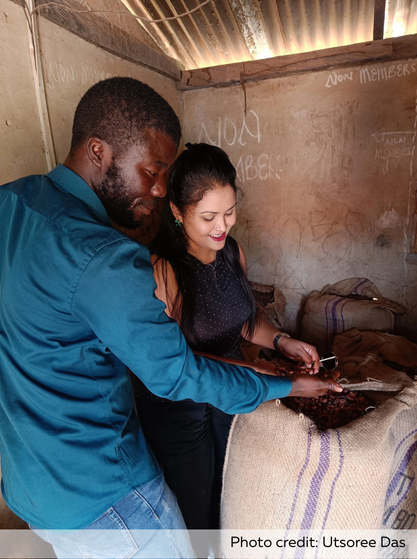
Tracing Every Bean Back to the Farm: A Field Visit to Ghana’s Cocoa Communities
During her second visit to Ghana, researcher Utsoree Das, University of Geneva, returned to the Nkawie district in the Ashanti region to continue work on a pilot study that aims to transform how cocoa transactions are recorded and how deforestation compliance is monitored. Her first visit was dedicated to scoping: visiting depots and sheds, meeting purchasing clerks, and allowing the research team to understand the local context in which small-scale cocoa farmers operate. Based on those initial insights, the team made a strategic decision to build a digital tool capable of streamlining and fully digitising the cocoa supply chain.
From Scoping to Digital Innovation
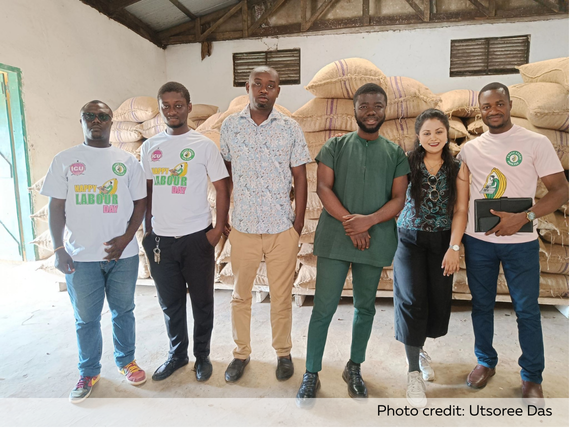
The result of that decision is an app designed to capture cocoa transactions across the cooperative. The tool has three versions tailored to different users and roles within the supply chain. The long-term intention is that, once the experiment concludes, the app can continue to function as a permanent system for measuring transactions.
During the pilot visit, the team tested the app in real field conditions. This revealed several areas where both the research design and the app itself needed adjustments. The field test also demonstrated how the digital tool interacts with the cooperative’s structure: once surveys are completed, they flow to the district level, where managers can access incoming transaction data and administer bag-level surveys that capture both quality and quantity. This enables a more accurate measurement of productivity while laying the foundation for robust traceability.
A Pilot Across Five Villages
The recent fieldwork took place across five villages in the Nkawie district. Some of these communities are remote, with limited access to modern amenities or digital technologies. For many farmers, this was the first time using a touchscreen device, highlighting both the need and the challenge of capacity building.
Despite these hurdles, the feedback was encouraging. Working closely with the Kuapa Kokoo Farmers Union/Kuapa Kokoo Limited and with the support of officers Anthony Anning and Kingsley Otchere, the team successfully conducted the preliminary test. The cooperative itself is large, with several thousand farmers, which underscores both the scale of the challenge and the potential impact.
Traceability, Compliance, and Farmer Realities
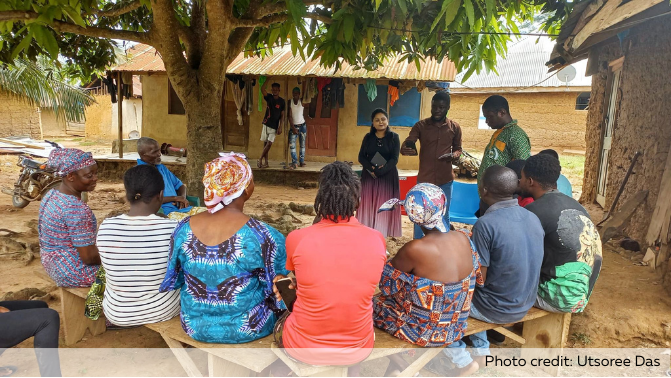
The core objective remains clear: “tracing every bean back to the farm.” Through digital innovation, the project seeks to strengthen traceability and measure compliance with emerging deforestation-free standards. A preliminary version of deforestation alerts has been computed already and installed in the system. Once new farmer data is collected, the team will generate an updated dataset of alerts meaning that next year, compliance assessments will rely on the most recent information.
At the same time, the fieldwork underscored the realities of smallholder farming. Many farmers face daily pressures and may not prioritise compliance requirements, especially when these are not yet mandatory. The experiment therefore, does not push or oblige participation. Instead, it demonstrates the potential benefits: that cocoa produced on deforestation-free land could, in the future, secure better prices and market opportunities.
Capacity Building and Continued Learning
Beyond technology development, the visit was deeply anchored in capacity building and data collection. The process brought researchers, purchasing clerks, district managers, and farmers into closer dialogue. For Utsoree, fieldwork is a grounding experience one that reshapes how research questions are understood and why they matter.
Quote: Being in the field “keeps you grounded and gives a renewed definition and meaning to your research.”
This team from the University of Geneva, Utsoree Das and Salvatore Di Falco (Dean, Geneva School of Economics and Management), working under the TRANSPATH project and in collaboration with Erik Katovich (University of Connecticut), and Mensah Tawiah Cobbinah (Wageningen University), will continue refining the app and the experimental design in preparation for the full RCT.
As the journey toward full traceability continues, the project is gaining a clearer picture of what it truly takes to trace every cocoa bean back to its origin and support a deforestation-free future for cocoa production.