Turn research into action: Introducing the TRANSPATH Action Guide
24 interactive guidelines to help researchers and bridge builders walk the pathways of transformative change for nature and climate.
Explore the Action Guide: transpath.eu/actionguide
IPBES defines transformative change as fundamental, system-wide shifts in views, structures and practices that address the underlying causes of nature's decline, and it is now invoked across research and policy as the answer to biodiversity loss and climate change.
Yet there is an uncomfortable gap. We know a great deal about why transformative change is needed, and much less about how to make it happen in practice. Most academic output still goes unread by the people who are actually driving change on the ground.
That gap is what the TRANSPATH Action Guide sets out to close. It is a free, interactive web-based guide that gives researchers and bridge builders 24 practical guidelines for turning knowledge into meaningful action.
Transformative change as a pathway you walk
In the TRANSPATH project, we think of transformative change as walking a pathway toward a nature-positive future. It is not a single decision or a policy switch, but a lived, cyclical process that shifts unjust and unsustainable values, structures and practices into ones that support the wellbeing of both people and nature.
Walking that pathway takes more than evidence. It takes reflexive muscles: the ability to keep learning, personally and collectively, through a continuous loop of action, evaluation, deep reflection and readjustment. We believe researchers are well placed to help build those muscles, in themselves and in the people they work with. The Action Guide is our attempt to make that practical.
Who it is for
The guide speaks to two specific groups.
Researchers, especially early career researchers. Whether you are desk-based or an action-oriented practitioner, you probably want your work to matter beyond publications, and you are open to interdisciplinary and transdisciplinary approaches. As one researcher we interviewed put it: "I want to make the most out of my research. I have time, but I don't know how."
Bridge builders: people who work for government, civil society organisations, think tanks, consultancies or communities, and who are best placed to connect research with policy and practice. In their words: "I am willing to support the ones in the field for embarking on a transformative change journey."
The rhythm of real change
Every guideline in the Action Guide is anchored in a cyclical process of three steps:
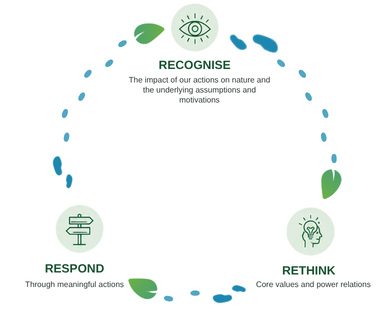
Recognise: the impact of our actions on nature, and the assumptions and motivations underneath them. Each guideline opens with reflection questions that invite you to look inward (what lenses shape the way you see things?) and a real-life case that shows a leverage point in action.
Rethink: core values and power relations. A visual actors map helps you consider with whom and for whom transformative change should be enacted, so that more voices are included and power imbalances become visible.
Respond: through meaningful actions. A step-by-step pathway guides you on how to take concrete action in your own context.
The cycle never really ends. Responding leads to new things to recognise, which leads to rethinking again. That is the point: transformation is learned by walking.
What is inside: 24 interactive guidelines
The guide has two branches, one for each audience.
For researchers, organised by research stage. Pick where you are in your project and find guidelines that fit:
Just starting: assessing your positionality, defining your research approach (including participatory and transformative methods, or downscaling global models), and moving from academic jargon to common ground.
Midway: involving the community, ensuring participation and including a plurality of voices, identifying stakeholders without causing fatigue, defining your own level of engagement with change (scholar activism), building trust, navigating transdisciplinary research, and using a justice compass.
Finalising: community-centred reporting, data synthesis and achieving shared understanding, mapping unjust and unintended consequences, and ensuring transformative impact.
For bridge builders, organised by enablers and constraints. Start from what is helping or hindering change in your context:
Enablers: human–nature connection, front-runners' enthusiasm and determination, public support for transformation, funding for transformative initiatives, value-driven finance, recognising a diversity of voices, and transformative governance.
Constraints: weak human–nature connection, actors' conformity and resistance to change, power imbalances, and bureaucracy.
Using it takes four steps: select your role, identify a challenge in your context, explore the action, and share your feedback.
A look inside one guideline
Take Developing a transformative vision, a guideline for bridge builders who want to harness the energy of change pioneers.
It starts by asking you to recognise: Can you recall an experience that made you believe change in your context is or is not possible? Even when we believe change can happen, our imagination often stays anchored in the present. Naming those experiences is the first step to imagining alternatives.
Then comes inspiration from a real case, that spur to rethink the way we see things: Paris's 15-minute city, where Professor Carlos Moreno's vision of a city with every essential within a short walk was turned by Mayor Anne Hidalgo into a policy agenda, down to opening schoolyards to neighbourhoods at weekends.
Finally, five steps help you respond: gather a diverse group of three to five people, warm up your imagination, explore multiple dimensions of sustainability (from water and energy to equity and community life), create a visual image of your shared vision, and iterate it through dialogue with people who can influence change, including sceptics. As the guide reminds you, it is "an inspiration guide, not a recipe". Every context is unique.
How we built it
The Action Guide rests on three theoretical pillars:
Ecological reflexivity (Pickering, 2019), which fosters the capacity to recognise responsibility, rethink views and structures, and respond creatively to biodiversity and climate challenges.
Social-emotional learning (CASEL framework), because transformative change is not merely rational. It involves perceptions, emotions and assumptions, so the guide invites an inward, personal journey.
IPBES leverage points (2024), so that each guideline points toward change in views (mindsets), structures (policies and governance) or practices (behaviours and narratives).
We co-created the guide with ten researchers across the TRANSPATH consortium through a design-thinking process in five stages: understand (reviewing existing guides and toolkits), ideate (interviews and workshops), define (narrowing to two user archetypes and identifying enablers and constraints from case studies in the Czech Republic and East Anglia), prototype, and validate with Wageningen researchers and bridge builders from an international NGO.
Three lessons from the process
Speak to someone, not everyone. Narrowing our audience from "policymakers and researchers in general" to two specific people made our knowledge translation more effective and more honest.
Less is more. We started with more guidelines and cut back, putting more effort into fewer, deeper ones.
Build early, not as an afterthought. Engagement products work best when they are developed early in a project's life. The Action Guide has also shown potential as a tool for internal reflexivity within research consortia themselves.
Start walking the pathway
If you are a researcher wondering how to make your work matter beyond the journal, or a bridge builder looking for practical ways to move people and institutions, the Action Guide is for you. Choose your role, pick the challenge that feels most alive in your context, and try one action.
Then tell us how it went. The guide is meant to grow through your feedback.