“Who is the solution?” TRANSPATH’s David Tàbara on regenerative pathways at the Cell Press Forum on Sustainability
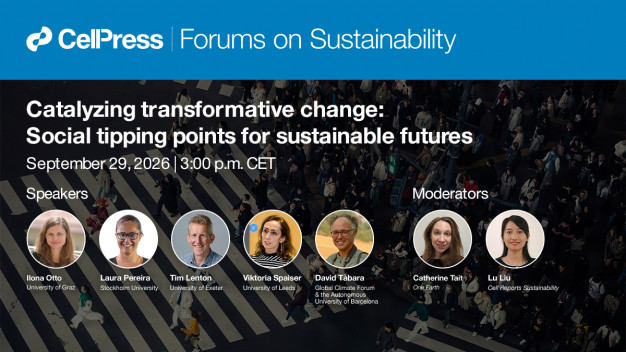
On 29 September 2026, TRANSPATH researcher David Tàbara (Global Climate Forum & the Autonomous University of Barcelona) spoke at the Cell Press Forums on Sustainability webinar “Catalyzing transformative change: Social tipping points for sustainable futures.” He joined Ilona Otto (University of Graz), Laura Pereira (Stockholm University), Tim Lenton (University of Exeter) and Viktoria Spaiser (University of Leeds). Catherine Tait (One Earth) and Lu Liu (Cell Reports Sustainability) moderated.
Find the recording here.
From “what is the problem” to “who is the solution”
David’s main point was that the key question for transformative change is not “what is the problem?” but “who is the solution?”, and how people can be empowered in their own contexts of action. Everyone has what he calls a pocket of agency: a specific position from which they can help build a global regenerative pathway towards a just and sustainable world.
He gave examples of what that looks like in practice:
- a farmer in Ghana joining a traceability system
- a cooperative pooling compliance efforts for smallholders
- a municipal government acting on its own land
- a portfolio manager adopting a duty-of-care standard
- a researcher producing the evidence that holds regulators accountable
Each of these actors can push transformative change forward from where they stand, as long as their actions follow sound ethical principles such as Earth system justice. The scale of change needed to avoid the worst effects of biodiversity collapse and climate change calls for a distributed, coordinated effort. Many different but complementary capacities have to work together to create net-positive synergies between social systems and biophysical conditions.
No neutral relationship with nature
David also stressed that humans have no neutral relationship with nature: everything we do affects life-support systems, for better or worse. That puts a simple question to every person and organisation: “Am I contributing to a degenerative or a regenerative development trajectory from where I stand?”
The research behind it
David’s contribution builds on a body of TRANSPATH-related work on positive tipping points and regenerative sustainability, including:
- Abrams, J.F. et al. (2026). Integrating tipping point concepts across diverse systems. Nature Communications Sustainability. https://doi.org/10.1038/s44458-026-00063-5. Fellow panellists Laura Pereira, Viktoria Spaiser and Tim Lenton are co-authors.
- Tàbara, J.D. (2026, forthcoming). Regenerative transformations: Learning to enact net-positive tipping points through whole-life systems paradigm shifts. In Kuenkel & Singh (eds.), Sustainability Transformations: A Multidisciplinary Approach. Edward Elgar.
- Gupta, J. et al. (2024). A just world on a safe planet: Earth system boundaries, translations and transformations. The Lancet Planetary Health, 8(10). https://doi.org/10.1016/S2542-5196(24)00042-1
- Tàbara, J.D. (2024). Positive tipping points towards global regenerative systems. Earth System Dynamics, 15(4). https://doi.org/10.5194/esd-15-853-2024
- Tàbara, J.D. (2023). Regenerative sustainability: Towards a relational model of possibilities for the emergence of positive tipping points. Environmental Sociology, 9(4). https://doi.org/10.1080/23251042.2023.2239538